On America’s 250th birthday, I am still that baby on the highway, still the boy churning ice cream in Verne’s yard.
This Fourth of July, America turns two hundred fifty. And when I think of this holiday, I don’t think of fireworks on a screen or a parade on television. I think of Verne’s house.
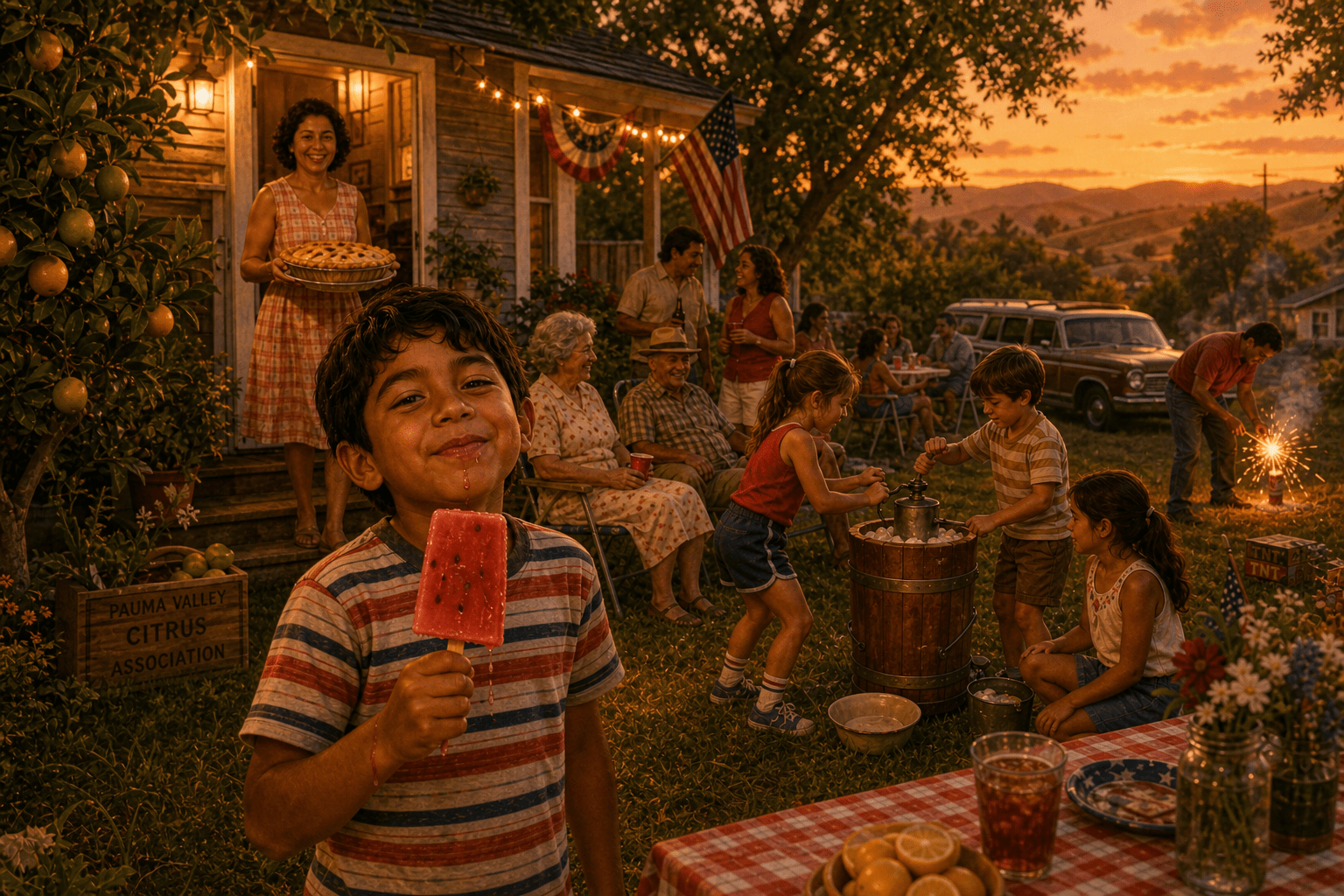
Verne would invite everyone. His children, his grandchildren, my parents, my sister, and me, all crowded into his yard on the Fourth. We took turns churning the ice cream by hand, the crank turning slower and slower as it froze, while Joyce carried out peach pies she’d made from the peaches growing on the trees behind their house. When it got dark, Verne brought out fireworks of his own, more enthusiasm than permit, until the firefighters showed up to have a word with him.
Verne and his entire family were Caucasian. My parents and I did not look like them, and they did not look like us. There was no pretending otherwise, not in that yard, not in that decade. But nobody in that gathering treated us like guests who had wandered in. We were treated like family. As if to say, without ever saying it out loud, immigrants belong in America.
I was not born in this country. But on afternoons like that, I was being remade in it. Somewhere between the hand crank and the peach pie and the fireworks that got Verne in trouble, I was not just living in America. I was becoming American.
On America’s 250th birthday, I am still that baby on the highway, still the boy churning ice cream in Verne’s yard.
But this year carries a second anniversary for me. Quieter. Personal. Not written into any history book but mine.
Fifty years ago, my parents brought me to the United States. I was a baby. I don’t remember the journey. I only know it because it was told to me, the way the most important parts of our story usually are… by the people who lived it before us.
The Highway
My parents crossed the Mexican American border on foot, carrying me. I was one year old. They walked into the unknown, into a highway near Julian, California, with little idea of the terrain ahead, the people, the language, or what waited for them on the other side. It is the same leap anyone takes when they step from the known into the unknown. Only this leap was made with a baby in their arms and no map for what came next.
My father waved a car down on the side of that highway.
A man stopped. A stranger with no reason to help, no obligation, no expectation of anything in return. Years later, my father would learn the only reason the man stopped at all was because he saw me, the baby, in my mother’s arms.
He picked us up and drove us to the Rincon Indian Reservation, just off Highway 76, in what is known today as Funner, California, near Pauma Valley. A place we had never heard of, among people we had never met, and yet it became the ground where our life in this country began.
I have spent my life trying to be worthy of that decision.
The People Who Believed Before I Could Prove Anything
That unnamed man was only the beginning.
There were Verne and Joyce Maynard, and Albert “Bud” and Penny Bradford, and Sherman Johnson, the managers of the immigrant camp where we found shelter when we had none. They did not know what I would become. They could not have known. There was nothing to see yet, no résumé, no promise fulfilled. Just a family that needed someone to believe in them before there was any evidence belief was warranted.
The shelter itself had no furniture. Bare walls, a bare floor, a family sleeping wherever there was room to sleep. That was the whole of what we arrived to. But we did not stay long, because my father moved us onto the Maynard farm not long after, into a small trailer home that suddenly felt like the beginning of something instead of the end of it.
The people who shape us most are rarely the ones who show up after we have proven ourselves. They are the ones who show up before.
And there was the paleta de sandía. I don’t remember much else from those earliest years, but I remember that. A watermelon popsicle, seeds and all, melting fast in the heat, sweet and cold and a little messy in a child’s hands. Even the seeds meant something. To this day, they carry a symbolic weight for me, small dark specks inside something sweet, life and possibility embedded in the simplest gift. That paleta did not stay behind in the camp. It kept finding its way back into my childhood, uninvited, at odd moments, the way the truest memories do. A small, ordinary kindness that a child does not forget, even when everything else about that time is a blur. Sometimes that is how grace arrives. Not as a grand gesture, but as a paleta shared with a family that had nothing, on a farm that had room for one more.
That is the part I have come to understand only with age. The people who shape us most are rarely the ones who show up after we have proven ourselves. They are the ones who show up before. Sometimes they show up with a spare trailer and a slice of watermelon, and that is enough to change the direction of a life.
Decades later, that same kind of belief found me again. At USC, where a Spanish Literature and Linguistics degree became the beginning of a career I could not have mapped out at eighteen. At Michigan Ross, where an EMBA classroom became the place I learned to lead, not just manage. Through John Hawkins, my predecessor, who saw something in a twenty something entry level employee and made room for it to grow across nearly three decades.
None of it was owed to me. All of it was given.
A Nation in the Support Circle
I call it a support circle, the people and institutions that carried my family and me when we had nothing to offer in return. Most of that circle has names and faces. Verne. Joyce. Bud. Penny. Sherman. But part of it does not, and part of it is bigger than any one person.
In 1986, President Ronald Reagan signed the Immigration Reform and Control Act, granting amnesty to immigrants who had been living in this country without documentation. My family was among those it touched. I remember the paperwork spread across our kitchen table, and my mother crying, not from sadness, but from a relief so profound it had nowhere else to go. A signature in Washington, and a family in Pauma Valley moved a little closer to belonging.
Then, in the early 2000s, the United States government approved my citizenship. A government that had every reason to see me only as a case number chose instead to see me as someone worth welcoming permanently. That approval was not just paperwork. It was the country finishing what the man on the highway started, saying yes to a baby it had already fed, sheltered, and educated for fifty years.
What Fifty Years Taught Me About Two Hundred Fifty
I have thought a lot about what it means to grow up inside a country’s promise rather than just its history.
America’s 250 years is the story of an idea that keeps insisting it is worth continuing… imperfectly, painfully, stubbornly. My fifty years is proof of what that idea looks like up close, in one life. A baby carried across a border on foot, handed off to a stranger on a highway because that stranger could not drive past a child in need, was decades later slicing watermelon for his own family and churning ice cream in the yard of people who looked nothing like him but called him family anyway.
Gratitude Is Not Enough Unless It Moves
I could stop here and simply say thank you. To the man on the highway. To Verne and Joyce. To Bud and Penny. To Sherman. To USC and Michigan Ross. To John Hawkins. To President Reagan and the government that later called me a citizen. To a country that, even at its most divided, still produces strangers willing to stop for a family they owe nothing to.
As CEO of the Employees Club of California and the Los Angeles City Employees Association, I now have the privilege of honoring, celebrating, and giving thanks to the very kind of people who once made room for a family like mine.
But gratitude that stays inside of us is incomplete. It has to move somewhere.
For me, it moves toward the fifty thousand public servants I have the honor of serving every day… the men and women who show up at DWP substations and fire stations and city offices and counties across California, doing the unglamorous, essential work that keeps a promise like America’s actually functioning. They are, in their own way, the highway stop for millions of people who will never know their names either. The permit approved on time. The emergency answered. The service delivered without fanfare.
I did not choose this country. It was chosen for me, by a young couple desperate enough to walk across a border with a baby in their arms and brave enough to keep going once they were here. But I have spent every year since trying to choose it back.
As CEO of the Employees Club of California and the Los Angeles City Employees Association, I now have the privilege of honoring, celebrating, and giving thanks to the very kind of people who once made room for a family like mine. It is my way of giving back to America through the public servants who keep her promises. For fifty years, I was carried by a support circle I did not choose and could not repay. Now, in whatever small way I can, it is my honor to be part of someone else’s.
I did not choose this country. It was chosen for me… But I have spent every year since trying to choose it back.
This Independence Day, on America’s 250th, I am not just celebrating a nation’s birthday.
I am celebrating the fact that a stranger on a highway once decided a baby was worth stopping for, and that a country has been saying yes to that same baby ever since.
Happy 250th, America. Thank you for stopping.
 Robert Larios