I think about this more than I probably should. Some debts are like that. They don’t let you look away.
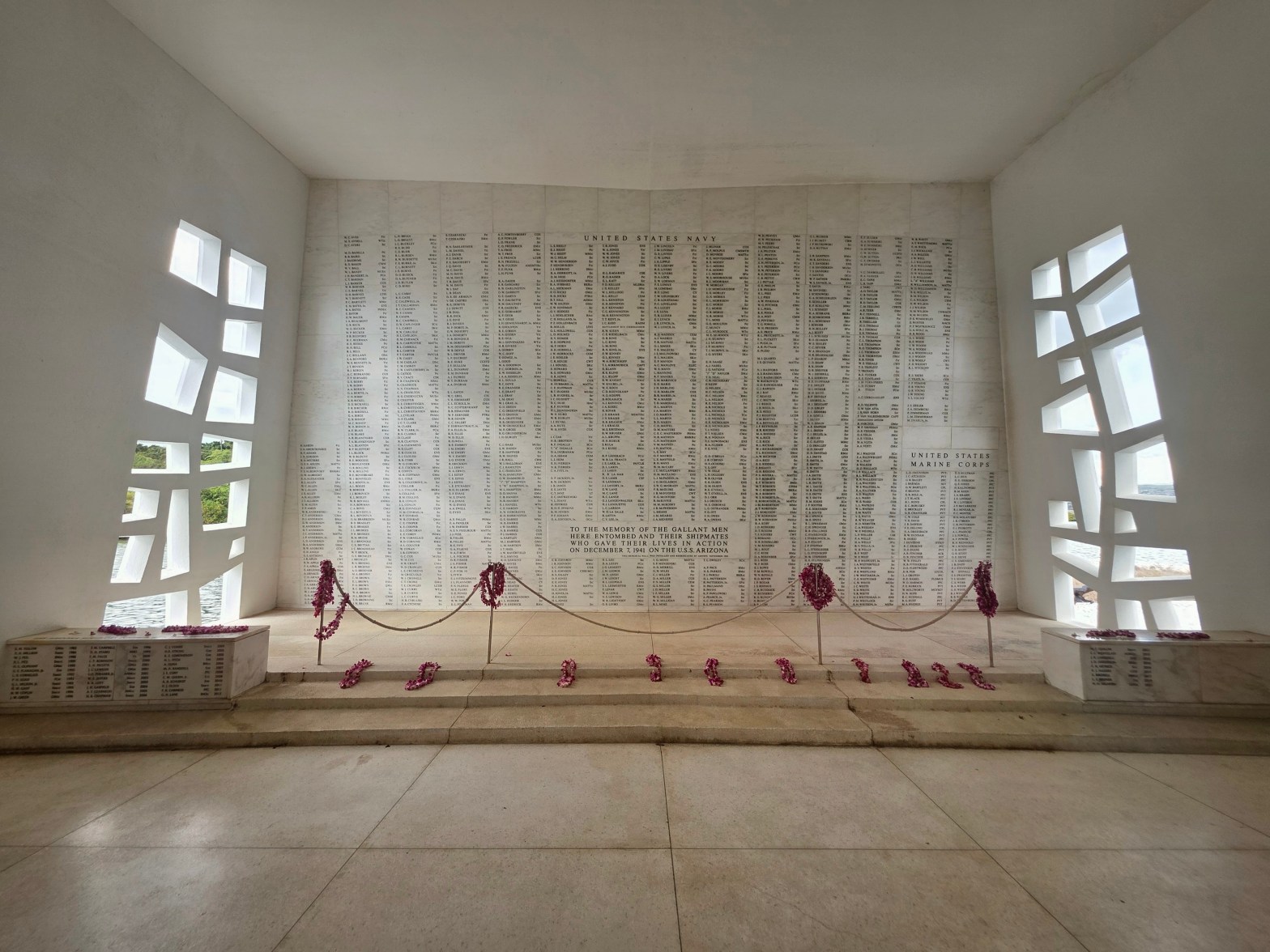
I started writing this from Pearl Harbor, or more accurately, I’m writing this after Pearl Harbor. Because standing inside that memorial, looking at that wall, I couldn’t have written anything. I couldn’t speak. I could barely breathe.
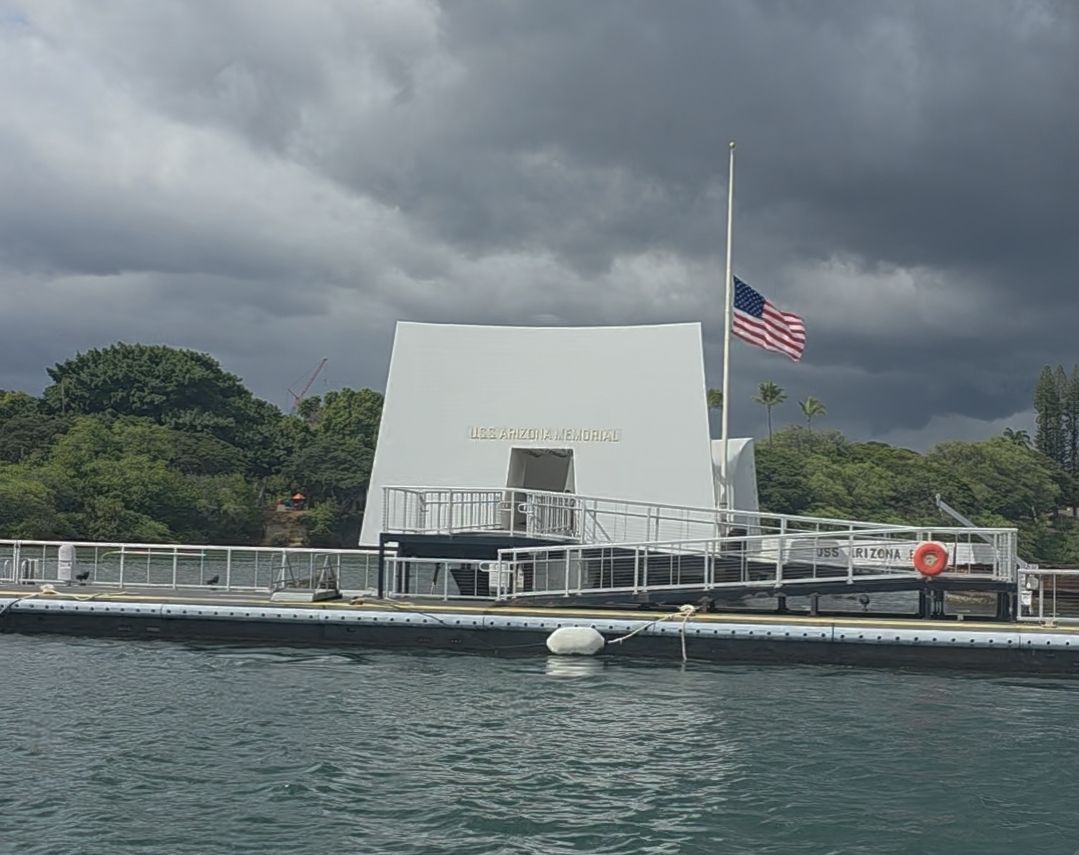
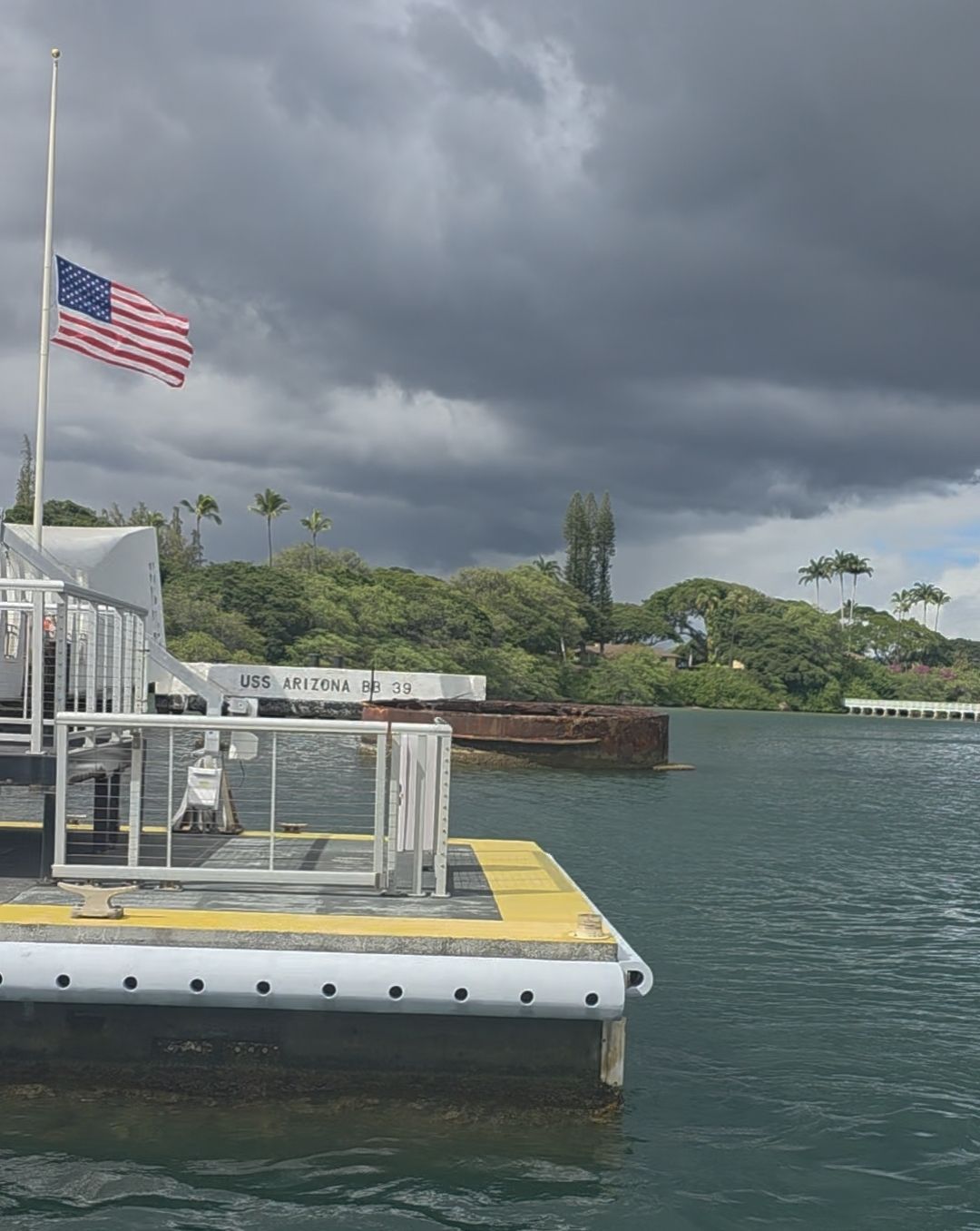
I’ve been to a lot of meaningful places in my life. Nothing prepared me for this. It wasn’t tourism. It wasn’t sightseeing. It was something closer to entering a cathedral that sits on top of a grave. The water beneath the memorial is still. The hull of the USS Arizona is still visible just below the surface. Oil still seeps from that ship more than eighty years later. They call it “the tears of the Arizona.” I don’t have a better word for what I felt standing there than holy.
What hit me all at once… the grief, the gratitude, the weight of names I didn’t know… was not one emotion. It was all of them at the same time. Standing in that shrine room, looking at hundreds of names carved in marble, I thought about what it means to be an American who was not born here. To have been carried across a border at eighteen months old and given a life in a country that boys from Iowa and Georgia and the Bronx died to defend.
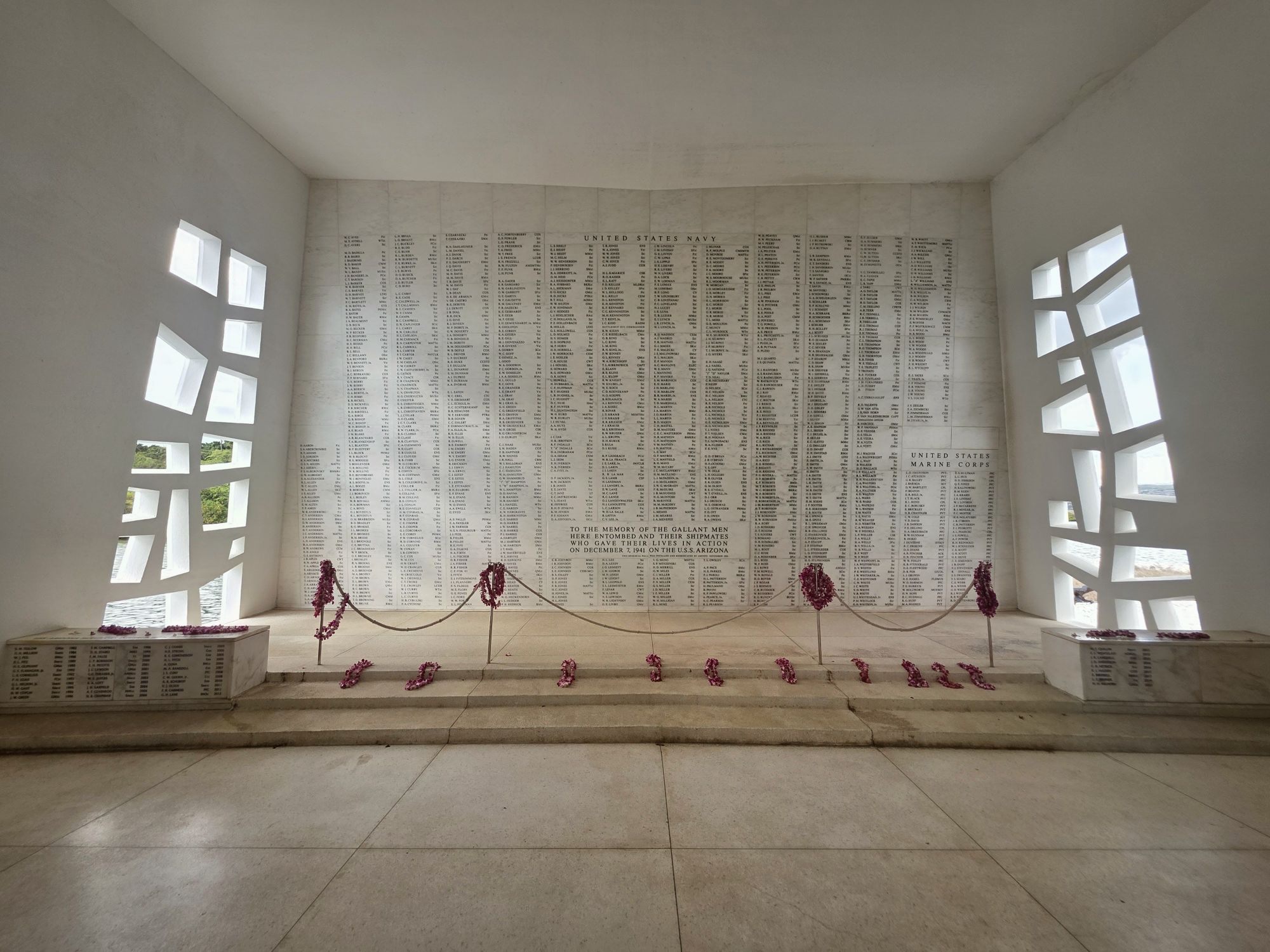
(The photos I’m sharing here are from that visit. I took them myself. I want you to see what I saw.)
Somewhere in Normandy, in the Philippines, in the mudfields of the Argonne Forest, there are white marble headstones that read: “Here rests in honored glory a comrade in arms known but to God.” No name. No rank. No hometown. Just a body, a cross, and an ocean between them and anyone who ever loved them.
But I want to be clear about something. The unknown fallen are not the only ones I carry today.
The known ones pain me just as much.
The ones whose names are on that wall. The ones whose families got a telegram. The ones who were somebody’s husband, somebody’s brother, and whose mothers spent the rest of their lives knowing exactly which patch of foreign soil held what was left of them. I don’t want to move past them in my grief for the unnamed. They gave everything too. They are not footnotes. They are the whole story.
They didn’t know me. They couldn’t have. They died anyway.
All of them… known and unknown… were somebody’s son. Maybe somebody’s father. And they died without ever knowing that a kid named Roberto would be born in Pihuamo, Jalisco, decades later, carried across the U.S.-Mexico border at eighteen months old, and eventually stand in a courtroom with his hand raised, swearing an oath to the same country they bled for.
They didn’t know me. They couldn’t have.
They died anyway.
I’ve spent a lot of my life thinking about the people who did know me. My parents, Rafael and Carmen, who carried me through that border with nothing but nerve and hope. The Maynards… Verne and Joyce… who gave my father work in the citrus and avocado groves of Pauma Valley and eventually sponsored our family through the 1986 amnesty. What I don’t say often enough: Verne was a World War II veteran. Purple Heart. He already knew what this country cost before he ever helped make room in it for us. Bud Bradford. Sherman Johnson. These are the faces of my American story. I know their names. I’ve shaken their hands.
Some of them are gone now. I can’t thank them in person anymore. That door closed.
But John Hawkins is still here, and I want to say something about him that I don’t think I’ve said loudly enough.
John hired me in 1998 to work at the Los Angeles City Employees Association… a young member services counselor, the son of a farmworker, still figuring out what he was capable of as a recent USC graduate. What I didn’t fully appreciate then was that John had walked those same grounds before me. He graduated from USC in 1993. He already knew what that degree could mean for someone who had to earn it. He spent the better part of the next two decades investing in me, shaping me, and ultimately handing me the keys to an organization he’d spent his career building. What most people don’t know is that before John Hawkins ever believed in me, he served.
Four years on a nuclear fast-attack submarine. USS Salt Lake City, SSN 716. Newport News. San Diego. He earned the Navy Achievement Medal from the Secretary of the Navy, the Good Conduct Medal, the Meritorious Unit Commendation and Expeditionary Medal. Life member of the Veterans of Foreign Wars.
The man who opened the biggest professional door of my life had already spent four years underwater, in the dark, in service to the same country I was still trying to become a legal part of.
I don’t think that’s a coincidence. I think that’s character. And I think character compounds.
There are more than 218,000 American war dead buried in overseas cemeteries managed by the American Battle Monuments Commission. Twenty-six cemeteries across sixteen countries. Thousands of those graves still don’t have a name on them. The ABMC buries them all the same way… no regard for rank, race, or creed. Equal in death in a way America didn’t always manage in life.
That last part matters. Because some of those unknown soldiers were Black men who fought in a segregated military. Hispanic men. Native Americans. Men who couldn’t always drink from the same fountain as the officers commanding them… but who died in the same mud, and now rest under the same marble.
They weren’t fighting for a perfect country. They were fighting for the idea that it could become one.
They weren’t fighting for a perfect country. They were fighting for the idea that it could become one.
The Defense POW/MIA Accounting Agency is still out there, right now, doing forensic DNA work to put names back on those headstones. Slowly replacing “Unknown” with someone’s actual name. It takes years. They keep going anyway. Because the belief is that nobody who died for this country should stay nameless forever.
I find that almost unbearably moving.
What it says is: we haven’t forgotten you, even when we can’t yet find you. That’s not bureaucracy. That’s a kind of love.
I stood at the USS Arizona Memorial. The flag was at half-staff. The harbor was quiet. Hawaiian leis had been laid along the base of the wall of names inside the shrine room… crimson against white marble. Someone placed them there because they still needed to. Because that’s what grief does when it has nowhere else to go. It finds an offering.
Today is a day of remembrance, gratitude, and grief. I felt all three last November at Pearl Harbor. And I feel all three again today.
I am the son of immigrants. I became an American citizen in a courtroom, not a hospital. The men and women remembered today… by name, without name, beneath land and sea… made room for that story before I ever existed to live it.
I don’t take that lightly.
I don’t take any of this lightly.
Today is a day of remembrance, gratitude, and grief. I felt all three last November at Pearl Harbor. And I feel all three again today.

